
In a previous review I reflected on the idea that war never truly changes. In the grim darkness of the far future, that statement feels even more absolute—there is only war. That idea sits at the very core of the Warhammer 40,000 universe, and it is precisely the setting for Battlefleet Gothic: Armada, a game focused on massive space fleet engagements drawn from Games Workshop’s legendary tabletop system.
For 40K fans, this period feels like a renaissance. Multiple games set in the universe are arriving in close succession, each trying to capture a different fragment of its vast lore. The real question, however, is whether this particular title manages to rise above the rest—or fade into the long history of ambitious but uneven Warhammer adaptations.
The Universe of Endless War
The Warhammer 40,000 setting is not simply a backdrop; it is an identity. Humanity, alien empires, and chaotic forces are locked in perpetual conflict across a decaying galaxy. While the lore can be inconsistent in places, its strength lies in tone rather than precision. It is oppressive, grand, and endlessly dramatic.
Battlefleet Gothic, the original tabletop experience, translated this universe into naval warfare among the stars. Massive warships—sometimes stretching kilometers in length—engage in brutal broadsides, boarding actions, and long-range bombardments. Combat is deliberately slow, weighty, and tactical, echoing the age of sail more than modern naval or space combat.
Each faction reflects a different philosophy of war. The Imperium relies on heavily armored vessels and overwhelming firepower. Chaos brings speed, corruption, and devastating lance weaponry. Orks fight with crude aggression and unpredictable tactics. Eldar emphasize speed and precision, striking like ghosts before disappearing into the void.
This asymmetry is what gives the setting its identity: no two fleets feel the same.
First Impressions and Beta Structure
The beta version of Battlefleet Gothic: Armada offers a limited but functional snapshot of what the full release aims to be. Multiplayer skirmishes form the core experience, alongside a basic progression system built around renown and fleet expansion. There are also early campaign missions, though only from the Imperial perspective.
At this stage, the game is clearly focused on testing systems rather than delivering a complete experience. Fleet construction, upgrades, and match structure are already in place, giving a sense of direction even if the full depth is not yet realized.
It is important to judge it as a framework rather than a finished product.
Gameplay Systems and Fleet Progression
At its core, the player takes on the role of a fleet admiral. Ships are earned, upgraded, and customized through a progression system based on renown gained from battles. As progression increases, larger and more powerful vessels become available, allowing for more complex fleet compositions.
Capital ships form the backbone of any fleet, while smaller escort vessels provide support and tactical flexibility. Each class has multiple variants, differing in weapons, armor, speed, and special abilities. This encourages experimentation, though in practice some upgrades feel significantly more valuable than others, leading to predictable meta choices.
Ship abilities and progression add a layer of persistence, but balance between options is uneven. Certain offensive abilities quickly become dominant picks, reducing strategic diversity in some cases. Ideally, future balancing would ensure that more upgrades remain situational rather than universally optimal.
Match Structure and Tactical Flow
Each engagement begins with mission selection—ranging from convoy protection to direct elimination or data retrieval. Fleet size is restricted by point limits, forcing players to make tactical decisions before the battle even begins.
Once deployed, battles unfold in relatively short sessions, typically lasting between five and ten minutes. This pacing is one of the most controversial design choices. While it keeps matches accessible, it also reduces the sense of scale that the Warhammer universe naturally suggests.
These are not slow, drawn-out fleet engagements in the traditional sense. Instead, they feel more like condensed tactical bursts. This creates a disconnect between lore expectations and gameplay reality.
Ships that are supposed to feel massive, ancient, and heavily crewed instead behave more like expendable combat units. The grandeur of naval warfare in the 41st millennium is partially lost in favor of speed and accessibility.
Tactical Depth and Ability Management
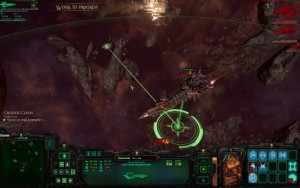
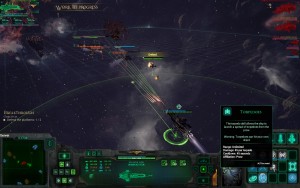
Despite pacing concerns, the game offers significant tactical complexity. Each ship can receive special orders such as defensive stances, accuracy boosts, or emergency maneuvers. Movement systems allow for speed adjustments, evasive actions, and positioning strategies that can determine the outcome of battles.
Additional mechanics include boarding actions, fighter and bomber deployment, torpedo salvos, and system targeting. This creates a dense combat environment where attention management becomes critical.
One of the most controversial but useful mechanics is the Tactical Cogitator, a slow-motion system activated during battles. It temporarily reduces game speed to allow players to issue commands more precisely. While some players dislike its impact on pacing, it undeniably improves accessibility in a game that can become overwhelming during large engagements.
Faction Identity and Strategic Variety
Faction design is one of the strongest aspects of Battlefleet Gothic: Armada.
The Imperium focuses on endurance and balanced firepower, Chaos emphasizes aggressive long-range engagement, Orks thrive on chaotic close combat, and Eldar rely on speed and evasion.
These differences are not cosmetic—they fundamentally change how each fleet must be played. Mission objectives also influence fleet composition, encouraging adaptive thinking rather than static builds.
However, balance between factions is still evolving. Some strategies feel more reliable than others, especially in early multiplayer environments where optimization is still emerging.
Presentation, Graphics, and Atmosphere
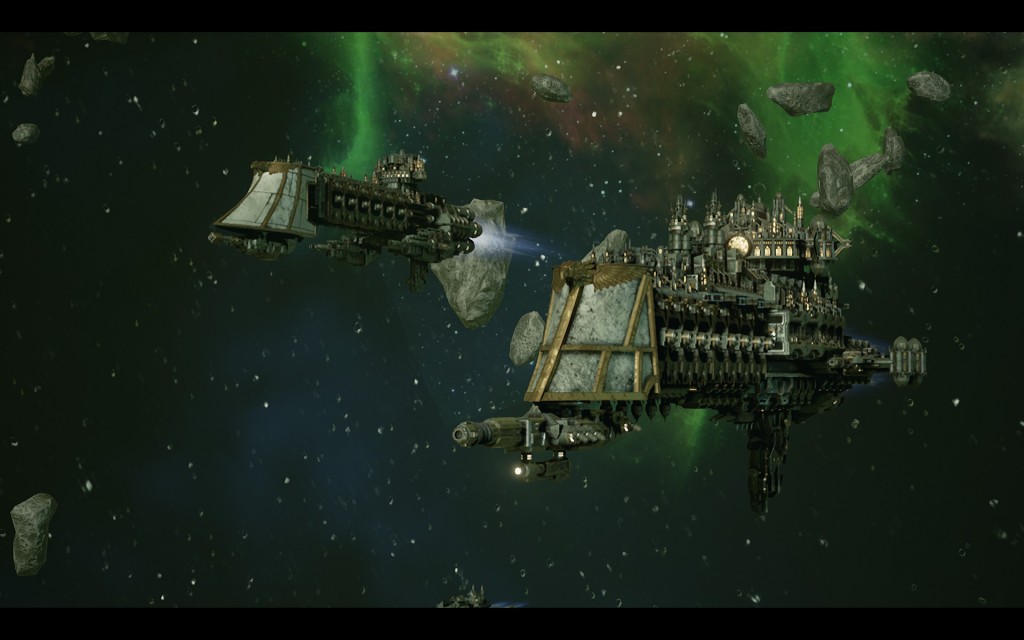
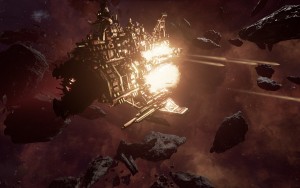
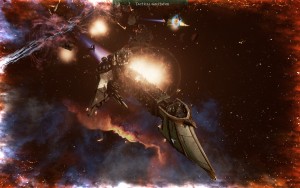
Visually, the game is impressive for its time. Space environments are detailed, ship models are highly intricate, and combat effects—such as warp jumps, explosions, and weapon discharges—are striking and immersive.
The scale of ships is generally well represented, reinforcing their importance within the battlefield. Weapon effects and engine visuals contribute to a strong sense of weight and power.
However, background design occasionally works against clarity. Certain environmental elements, such as asteroids or structures placed for visual depth, can confuse spatial awareness during combat. At times, they interfere with readability rather than enhancing immersion.
There are also minor technical issues such as brief screen tearing during transitions, as well as limited camera zoom options that restrict full appreciation of battlefield scale.
Audio Design and Immersion
Sound design is one of the game’s strongest pillars. Weapon fire, engine hums, and ship communication effects all contribute to a convincing portrayal of space warfare. While space is technically silent, the audio direction successfully conveys scale and intensity without breaking immersion.
The atmosphere aligns closely with other Warhammer 40K titles, capturing the bleak, industrial tone of the universe.
Interface and Usability
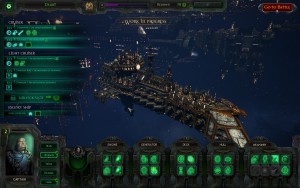
The user interface is functional but dense. There are many commands, ability toggles, and tactical options layered into a relatively compact layout. While experienced players will adapt quickly, newcomers may find the learning curve steep.
Tooltips and UI feedback are inconsistent at times, occasionally providing either too little or poorly structured information. A more intuitive command system—such as radial menus—could significantly improve accessibility.
Replayability and Progression
Replay value largely depends on multiplayer engagement and future campaign expansion. At present, the renown system provides motivation to continue playing, but progression feels somewhat fast and lightweight.
Fleet loss mechanics introduce meaningful consequences, but they are not punishing enough to create long-term strategic tension. A deeper persistence system—such as lasting ship degradation or permanent consequences—could strengthen the campaign feel.
Match variety is decent but could benefit from broader mission types and improved matchmaking systems.
Modding and Longevity
One of the weaker areas is mod support. Unlike games that thrive on community content, Battlefleet Gothic: Armada does not currently emphasize modding. Given the history of Games Workshop licensed titles, this is not surprising, but it does limit long-term community-driven evolution.
Without robust mod tools, the game risks becoming static once official content is exhausted.
Final Assessment
Battlefleet Gothic: Armada presents a strong foundation for a Warhammer 40,000 naval combat experience. It successfully captures the aesthetic, tone, and faction diversity of the universe, while offering engaging tactical gameplay and impressive presentation.
However, it is not without flaws. Pacing issues, limited strategic depth in some systems, uneven upgrade value, and a lack of robust long-term content tools prevent it from fully realizing its potential at this stage.
It stands as a promising but still incomplete interpretation of space warfare in the 41st millennium—one that could evolve into something exceptional, or remain a niche tactical experience depending on post-launch support and balance refinement.