

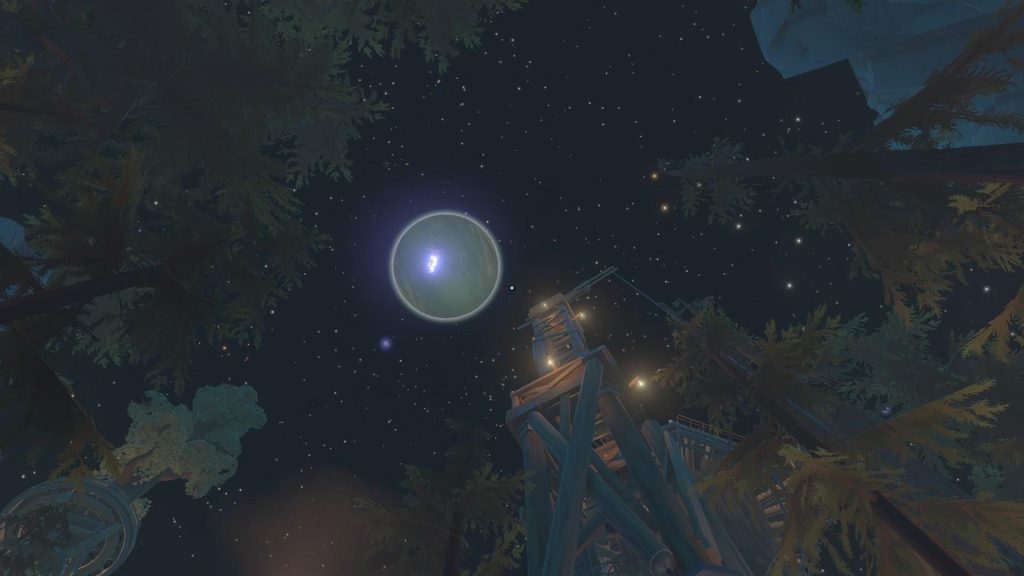
What happens when you build a game not around progression systems, not around combat loops, not around loot or leveling — but around curiosity itself?
You get something rare. Something almost fragile in its design philosophy. You get Outer Wilds.
It is not just an exploration game. It is a structured invitation to wonder. A carefully constructed simulation of discovery where the only real mechanic is attention — and the only real reward is understanding.
This is a spoiler-free review.
Awakening Into the Unknown
You begin in a moment that feels almost insignificant at first. You wake up, disoriented, with the quiet weight of something vast hovering above you: a living solar system that already feels ancient, even though you’ve just arrived in it.
Nearby, something explodes in the sky — distant, beautiful, and unsettling in equal measure.
There is no dramatic mission briefing. No urgent directive. No cinematic voice telling you what to do next.
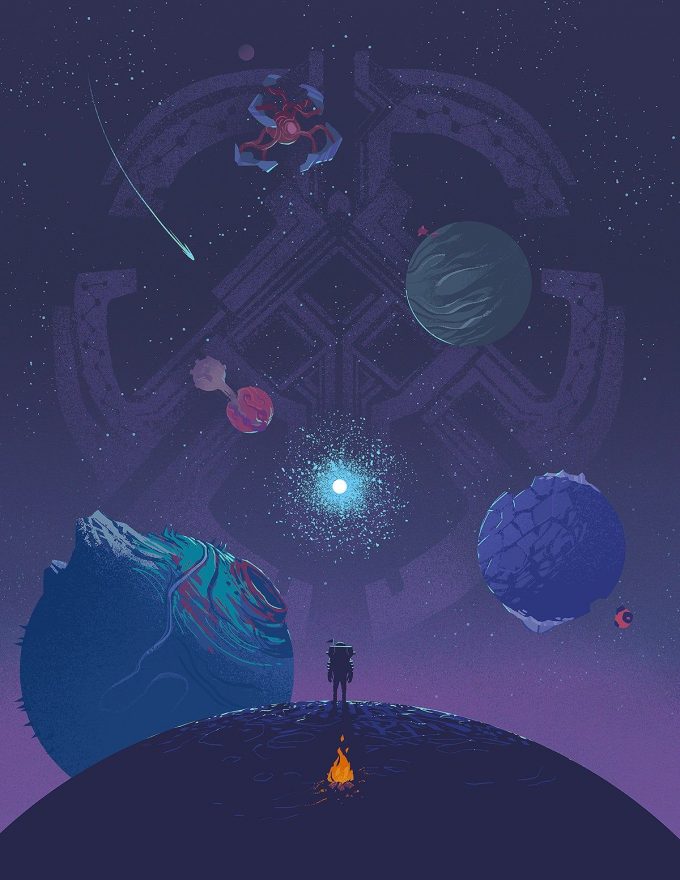
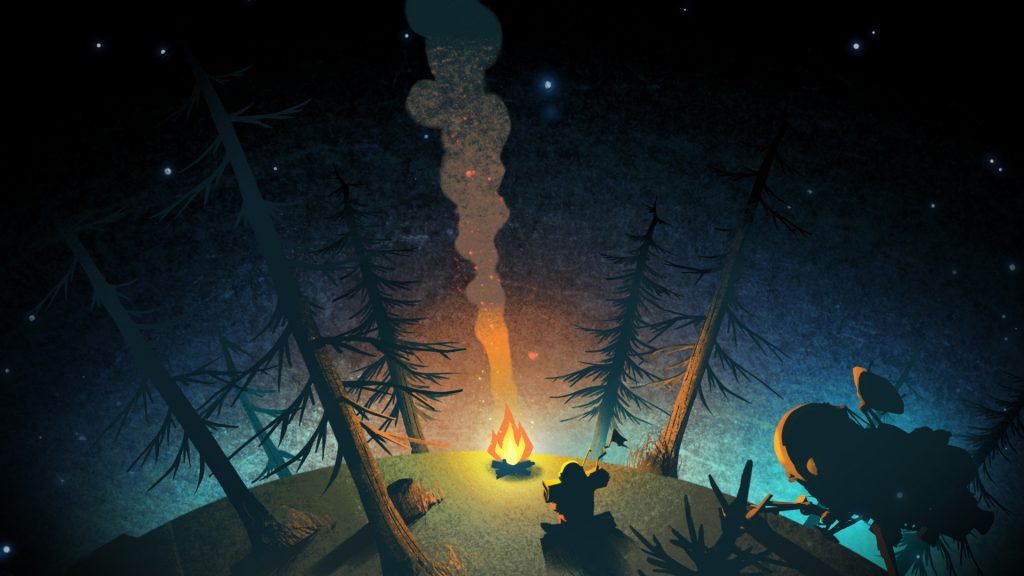
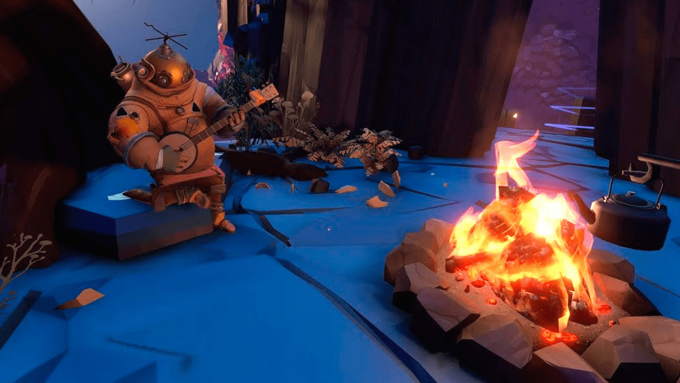
Instead, you are gently released into a small, handcrafted world: a village perched beneath an observatory, a series of simple interactions, and a sense that everything around you is quietly waiting to be noticed.
This opening sequence — often mistaken for a tutorial — is actually the game’s first philosophical statement.
It teaches without declaring that it is teaching. Every mechanic you need is already present. Every rule of the world is already embedded in the environment.
There are no future upgrades that will unlock progression. No hidden abilities waiting behind a skill tree. What you see is what you get — and what you learn is what you carry.
A Tutorial That Is Not a Tutorial
The starting area is one of the most elegant onboarding spaces in modern game design.
Without explicit instruction, it introduces:
- zero-gravity movement
- ship controls
- environmental storytelling
- observational thinking
- and, most importantly, curiosity as a mechanic
The museum beneath the observatory is particularly important. It is not just decorative lore — it is a structured introduction to how the universe thinks.
Artifacts raise questions rather than answers:
- What is this alien structure?
- Why is this object behaving unnaturally?
- Who built these ruins, and why are they silent?
The genius of this design is that the player begins forming “quests” mentally before the game ever defines one.
But Outer Wilds never confirms those quests in the traditional sense. Instead, it replaces them with something more fluid: threads of knowledge.

No Quests. Only Threads.
One of the most radical decisions in Outer Wilds is the absence of a traditional quest system.
There is:
- no mission log
- no objective markers
- no structured progression tree
Instead, there is a web of information — a knowledge system that expands as you explore.
Each discovery does not push you forward. It branches outward.
You are never told:
“Go here next.”
You are only ever given:
“You might want to understand this.”
And that subtle difference changes everything.
You are free to:
- follow a clue
- ignore it
- abandon it mid-way
- or simply drift toward whatever planet looks interesting in the moment
The game does not punish curiosity. It depends on it.
The Ship Log as a Living Mind Map
All discoveries are recorded in your ship’s computer — not as a checklist, but as a network of connected ideas.
Rather than a linear journal, it behaves like a cognitive map:
- nodes connect to unknown nodes
- gaps remain intentionally visible
- mysteries remain unresolved until personally pursued
This transforms progression from “task completion” into “pattern recognition.”
You are not leveling up.
You are assembling understanding.
And that distinction is crucial.
The 22-Minute Universe
At the heart of Outer Wilds lies its most defining mechanic: a 22-minute solar cycle that ends in universal collapse.
The sun explodes. The system resets. You begin again.
At first, this feels like a limitation.
But it quickly becomes the game’s philosophical core.
Time is not a resource to be optimized. It is a constraint that gives meaning to observation.
Each loop becomes:
- a hypothesis
- a field experiment
- a fragment of a larger investigation
Some loops are spent exploring distant planets. Others are spent solving a single small mystery. Sometimes nothing “important” is achieved at all — and that is still progress.
Because knowledge persists even when time does not.
A Game Built on Curiosity, Not Rewards
There is no loot system. No upgrades. No stat progression.
Instead, there is only:
- information
- context
- and discovery
This is where Outer Wilds separates itself from almost every other exploration game.
Most games reward action.
Outer Wilds rewards attention.
You are not becoming stronger. You are becoming more aware.
Exploration as Emotional Structure
Every planet in the solar system behaves like a puzzle, but not in the conventional sense.
They are not obstacles to overcome — they are systems to understand.
Each environment contains:
- shifting geography
- environmental hazards
- hidden historical context
- layered narrative fragments
And crucially, none of these are isolated. Everything is connected through implication.
Exploration becomes less about “where to go” and more about “what this means.”
Sound and Atmosphere as Memory Triggers
The soundtrack deserves particular attention.
It is not simply background music. It is a memory system.
Each location has its own tonal identity:
- quiet acoustic themes for isolated places
- tense, minimal compositions for unknown zones
- emotional resonance tied directly to discovery
The effect is subtle but powerful: music becomes a marker of understanding.
Even long after playing, specific melodies act as triggers — recalling not just places, but the moment of realizing what those places meant.
Ambient sound design reinforces this sense of fragile existence. Space feels alive, but not hostile. Quiet, but never empty.
Visual Design: A Small Universe With Large Meaning
The solar system is intentionally compact.
Distances are short. Planets are small. Movement is fast.
This is not a limitation — it is a design choice.
By reducing scale, the game increases density of meaning. Every landmark matters. Every visual anomaly suggests intention.
There are no filler spaces. Every corner of the universe implies narrative weight.
Even silence feels structured.
Flight, Physics, and Control
Ship handling sits in a delicate balance between realism and accessibility.
It is:
- physically grounded
- slightly unforgiving
- but never unfair
Learning to fly is part of learning to think in the game’s logic system.
You are not just navigating space. You are navigating consequence.
Replayability and Finality
Once the mystery is solved, Outer Wilds naturally loses its forward momentum.
This is not a flaw. It is a structural truth.
The game is designed as a single cognitive journey — not an endlessly repeatable system.
Its replay value lies not in mechanics, but in memory:
- revisiting early misunderstandings
- reinterpreting known locations
- noticing patterns previously invisible
But it is not a game meant to be consumed repeatedly. It is meant to be understood once, deeply.
Immersion Through Silence and Absence
One of the game’s quiet strengths is how much it refuses to overpopulate its world.
There is minimal NPC interaction. Dialogue exists, but it is restrained — almost observational rather than reactive.
This creates a sense of solitude that is intentional rather than empty.
You are not part of a living society.
You are an observer of a system that no longer needs you.
Challenge Through Understanding, Not Difficulty
Puzzles in Outer Wilds are rarely about mechanical skill.
They are about:
- timing
- observation
- environmental reading
- and conceptual connection
Many solutions do not feel like “solving puzzles” in the traditional sense. They feel like realizing you were missing a perspective.
That moment of realization — not execution — is the reward.
A Game That Trusts the Player
Perhaps the most important design decision in Outer Wilds is trust.
The game trusts you:
- to get lost
- to fail
- to misunderstand
- to revisit ideas
- to make your own narrative structure
There is no correction system guiding you back to the “correct” path.
Because there is no single path.
Final Thoughts: A Universe That Exists to Be Understood
Outer Wilds is not a game about saving the world.
It is a game about understanding why the world behaves the way it does.
It replaces:
- objectives with curiosity
- progression with knowledge
- reward systems with realization
And in doing so, it creates something rare in modern games: a sense of genuine intellectual discovery.
It does not demand your attention.
It earns it.
And once it has it, it never wastes it.
Verdict
Outer Wilds is not just an exploration game.
It is a carefully constructed argument about why exploration matters in the first place.
A quiet masterpiece built on patience, curiosity, and trust.
Play it blind. Do not look up answers. Do not optimize your experience.
Just explore — and let the universe reveal itself at its own pace.