

There has long been a single name sitting on the throne of theme-park tycoon games: RollerCoaster Tycoon 3 and its predecessors defined an entire genre. For many years, nothing truly managed to challenge its authority. Even when the series slowed down after its peak, no successor convincingly replaced it. The crown simply stayed where it was—not because it was actively defended, but because no challenger was strong enough to take it.
That long period of stagnation created a vacuum. Fans wanted evolution, not recycled mobile spin-offs or half-finished attempts. When new entries under the RollerCoaster Tycoon name arrived and failed to capture the magic, the disappointment only deepened. Projects like RollerCoaster Tycoon World were supposed to revive the franchise, but instead highlighted how far the series had drifted from its legacy. Development instability, shifting studios, and unclear vision left the impression of a throne without a worthy heir.
A genre waiting for a new ruler
Tycoon games thrive on depth, creativity, and systems that feel alive. The early success of RollerCoaster Tycoon wasn’t just about building rides—it was about understanding visitors, managing park economics, and watching a living system react to your decisions. Later entries increasingly struggled to balance creativity with simulation depth, and many players eventually moved on.
During this gap, nostalgia became a powerful force. Players remembered the simplicity and clarity of earlier games, especially the original titles and the more refined structure of RollerCoaster Tycoon 3. Even as graphics aged and mechanics showed their limits, the core experience remained influential.
But nostalgia alone doesn’t sustain a genre. Eventually, something new had to emerge.
Enter Planet Coaster
From Frontier Developments comes a new challenger: Planet Coaster. Interestingly, this is not an outsider studio attempting to reinvent the wheel. Frontier had already worked on earlier entries in the RollerCoaster Tycoon lineage, including expansions and later iterations. That makes this project feel less like a rebellion and more like a developer returning to reclaim creative control over ideas it once helped shape.
Unlike rushed successors that tried to capitalize on the name, Planet Coaster approached development in stages. Its early access structure wasn’t an afterthought—it was part of the plan. The idea was to build the foundation first, then gradually expand systems like coaster physics, terrain tools, and simulation layers.
At its core, the game launched initially as more of a creative sandbox than a full management simulation. That distinction matters. Instead of overwhelming players with incomplete systems, it focused on letting them build, experiment, and understand the tools first.
Building the foundation: creativity first
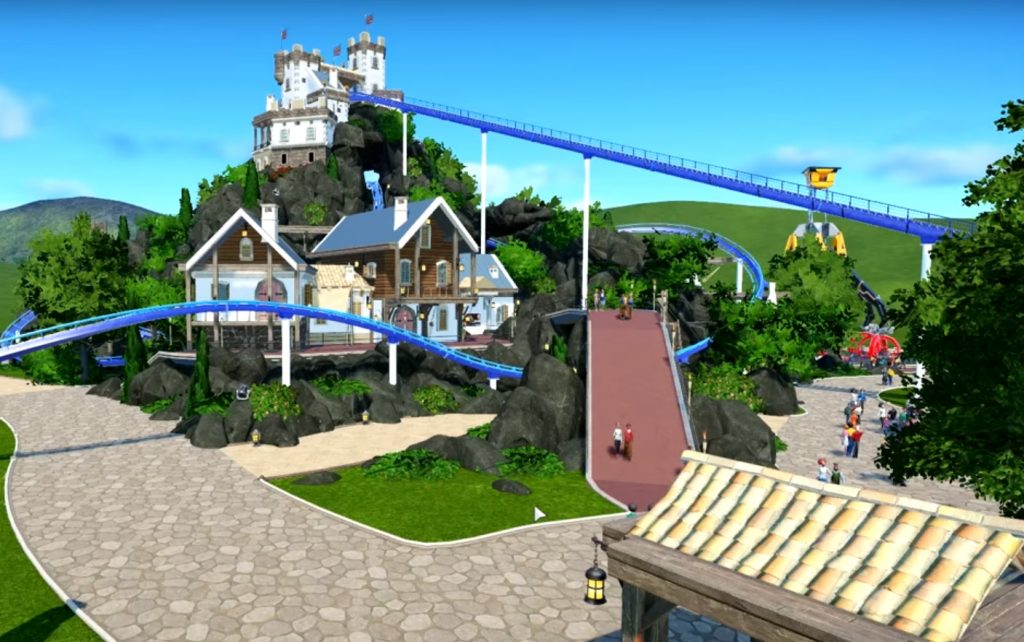
One of the strongest aspects of Planet Coaster is its construction system. Instead of relying heavily on predefined structures, the game gives players modular building tools. Walls, roofs, decorations, props—everything can be combined freely to create custom architecture.
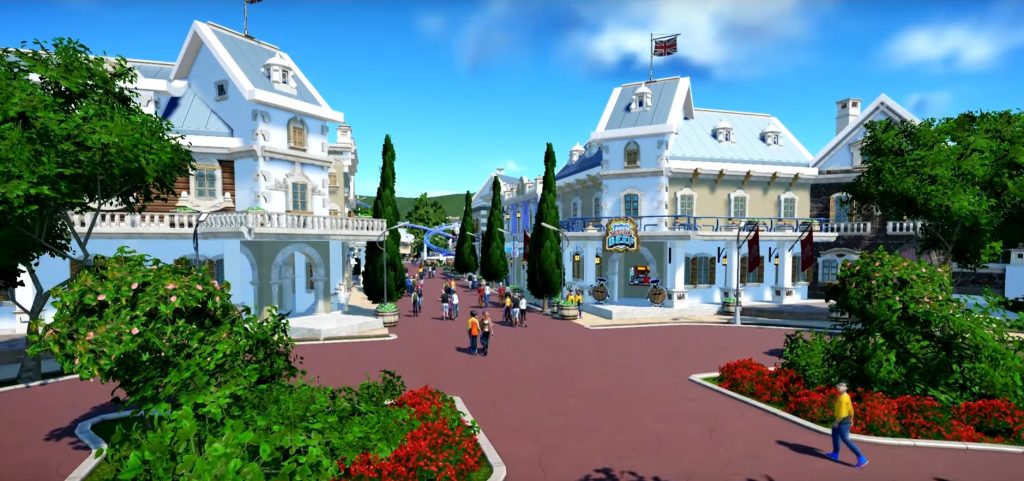
This level of control pushes the game beyond traditional tycoon design. You are not just placing objects; you are effectively designing theme park identity from scratch. Shops, entrances, and themed zones can all be visually customized to a degree that earlier games never fully supported.
The system is not without friction. Path-building in early versions can feel unintuitive, and some tools require refinement. But even with those limitations, the creative ceiling is significantly higher than what players were used to in older titles.
Where earlier games leaned on charm and simplicity, Planet Coaster leans on freedom and precision.
Coaster design and realism
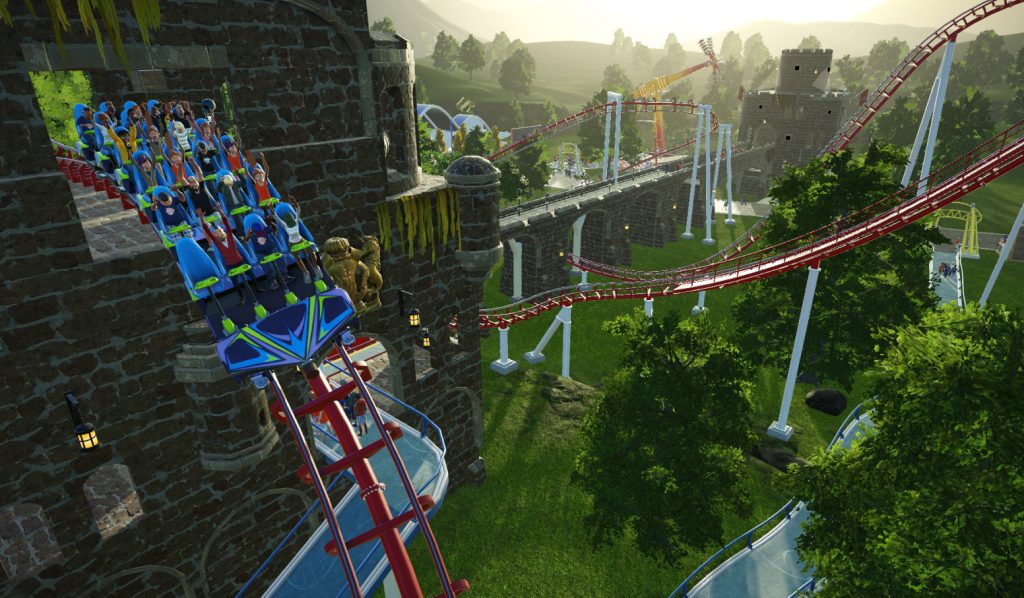
Roller coaster construction has always been the heart of the genre, and this is where Planet Coaster makes its strongest argument.
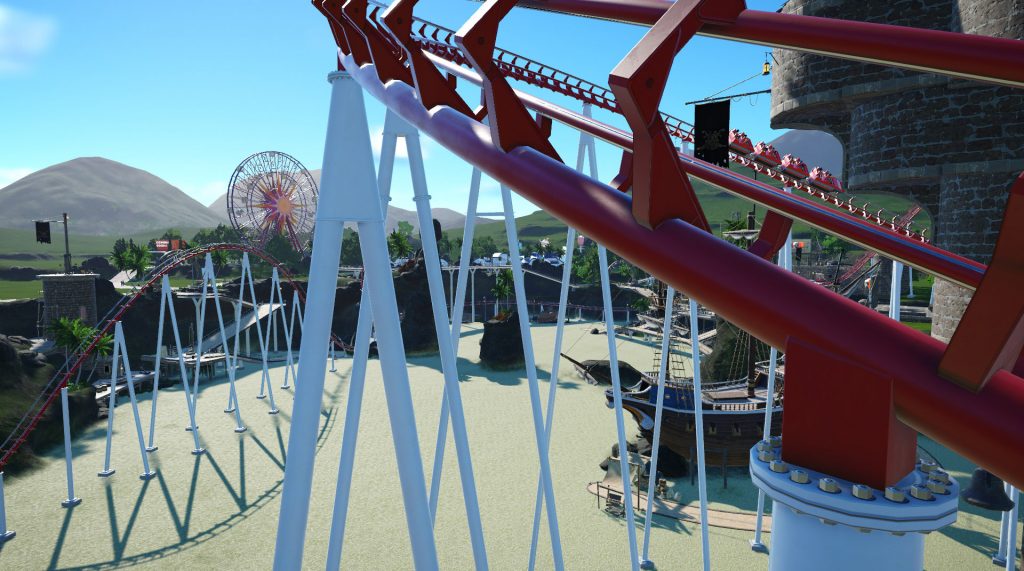
The physics system emphasizes realism. Tracks behave in ways that feel structurally believable. Supports are generated based on actual load requirements rather than purely decorative rules. Inclines, banking, speed transitions, and braking systems all interact in a way that forces thoughtful design.
This is not just about making something that looks exciting—it’s about making something that would plausibly exist in a real park. That design philosophy aligns the game closer to engineering simulation than arcade-style construction.
Even early implementations of coaster building feel surprisingly stable and satisfying, despite the system still being under development during early access phases.
Atmosphere, sound, and immersion
Where the game unexpectedly excels is atmosphere.
Visually, the engine delivers high detail across all levels of zoom. From wide aerial views to ground-level perspectives, the park feels cohesive. Lighting, weather effects, and environmental variation help create a sense of place rather than just a constructed map.
Crowds are especially important. Visitor animations and audio design make the park feel alive. The soundscape—ranging from distant chatter to mechanical ride sounds—adds a layer of immersion that older games only hinted at.
Coaster audio design is particularly strong. Chain lifts, braking systems, mechanical clanks, and environmental echoes all contribute to a convincing ride experience. This is one of the areas where the game clearly surpasses many of its predecessors.
Simulation depth and missing systems
At its early stage, Planet Coaster was not a full management simulation. Core systems like budgeting, research progression, and economic pressure were either simplified or not yet implemented.
This creates a divide in expectations. Players looking for a deep tycoon management experience may initially find it lacking. However, as a foundation, it is clear that the focus is on building systems first and layering management complexity later.
This design approach is risky but intentional. Instead of launching a complete but shallow simulation, the developers chose to prioritize strong construction mechanics and immersive presentation, then expand gameplay depth over time.
Shops, functionality, and limitations
One of the more controversial design choices is how functional buildings are handled.
While players can create incredibly detailed structures that look like restaurants or shops, actual operational buildings often remain simplified. Functional zones are abstracted rather than fully simulated interiors.
This leads to a contrast between visual creativity and mechanical simplicity. A building may look complex and realistic, but its gameplay function might be reduced to a basic interaction point.
Some players see this as a limitation. Others see it as a necessary compromise to keep performance stable and gameplay readable. Either way, it reflects a clear design decision: prioritizing large-scale park readability over granular interior simulation.
Camera, controls, and user experience
Control systems are generally functional but not perfect. Camera movement can feel inconsistent depending on settings, especially when switching between building modes and free movement.
Path construction also occasionally disrupts player flow, particularly when the camera recenters unexpectedly. These issues do not break the experience, but they do interrupt it.
On the positive side, free camera mode is a major strength. Being able to move through parks at ground level or observe rides from a passenger perspective significantly enhances immersion.
Modding and community potential
A critical factor for any tycoon game is longevity, and that often depends on modding support.
Historically, games like Cities: Skylines demonstrated how powerful community content can be. Modding extends lifespan, fixes limitations, and transforms a good game into a platform.
Planet Coaster’s future success is closely tied to how well it supports community sharing, custom content, and player-generated scenarios. Even if full modding tools are not available immediately, long-term support would be essential for maintaining relevance.
Without it, the game risks becoming static. With it, it could evolve far beyond its original scope.
The broader comparison: genre evolution
The situation mirrors what happened in the city-building genre. A once-dominant franchise stalled, struggled with modernization, and ultimately lost its position when newer, more flexible systems appeared. The arrival of Cities: Skylines showed what players actually wanted: deeper systems, mod support, and creative freedom.
The tycoon genre for theme parks is undergoing a similar transition. Legacy titles established the foundation, but modern expectations demand more flexibility, better simulation layering, and stronger creative tools.
Planet Coaster represents that transition point.
Final perspective
Whether Planet Coaster becomes the undisputed “king” depends on what metric is used.
If the standard is pure management simulation depth, the early version is incomplete. If the standard is creative freedom, immersion, and modern construction tools, it already shows strong dominance over its predecessors.
The more realistic conclusion is that the throne is no longer a fixed position. Instead, the genre is splitting into different strengths: deep simulation on one side, and creative sandbox experience on the other.
Planet Coaster does not simply imitate the past—it redefines what a modern theme park builder can be. Whether it fully claims the crown depends not on nostalgia, but on how far its systems evolve beyond its early foundation.