



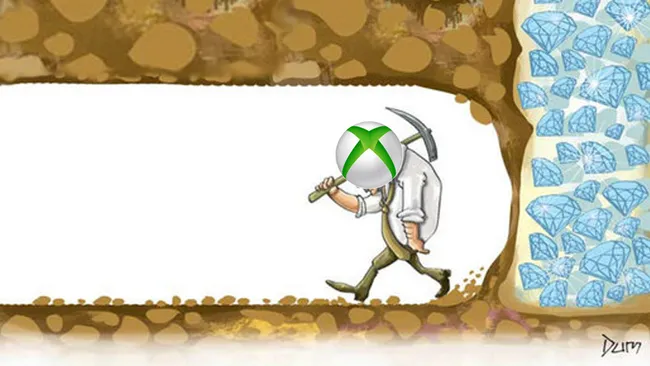
There’s an old webcomic called Persistence that keeps coming to mind whenever I think about Xbox’s current direction. In it, two miners are digging through rock. One of them gives up, exhausted, right before the other strikes diamonds.
That image captures something that feels increasingly relevant to Microsoft’s gaming strategy: a tendency to abandon long-term bets just before they have a chance to pay off.
It’s a pattern that has shown up across Microsoft’s history in various forms—missed computing transitions, half-committed product lines, and abrupt strategic pivots. And now, it feels like we’re watching a version of that same instinct play out again with Xbox.
A Shift Toward “Sustainability” — Whatever That Means
Microsoft’s current leadership has reportedly given Xbox a mandate to become more “sustainable.” On paper, that sounds reasonable. Any large business needs to manage costs and ensure long-term viability.
But the timing raises questions.
Xbox has, by multiple internal and external measures, posted strong or even record financial performance in recent years. Yet decisions are increasingly being made not on what the division has achieved, but on projections, forecasts, and internal targets for future efficiency.
That distinction matters. Because when companies begin optimizing heavily for what might go wrong, they often start cutting into the very foundations that make future success possible.
Recent reporting has suggested Xbox may end the year with what Microsoft considers a narrow “accountability margin,” driven by a mix of factors: pricing changes to Game Pass that were later reversed, hardware and supply constraints, and a softer year for key franchises like Call of Duty and Candy Crush Saga. These are real pressures—but also cyclical ones. They tend to fluctuate, not define an entire platform’s long-term trajectory.

The Risk of Cutting Too Early
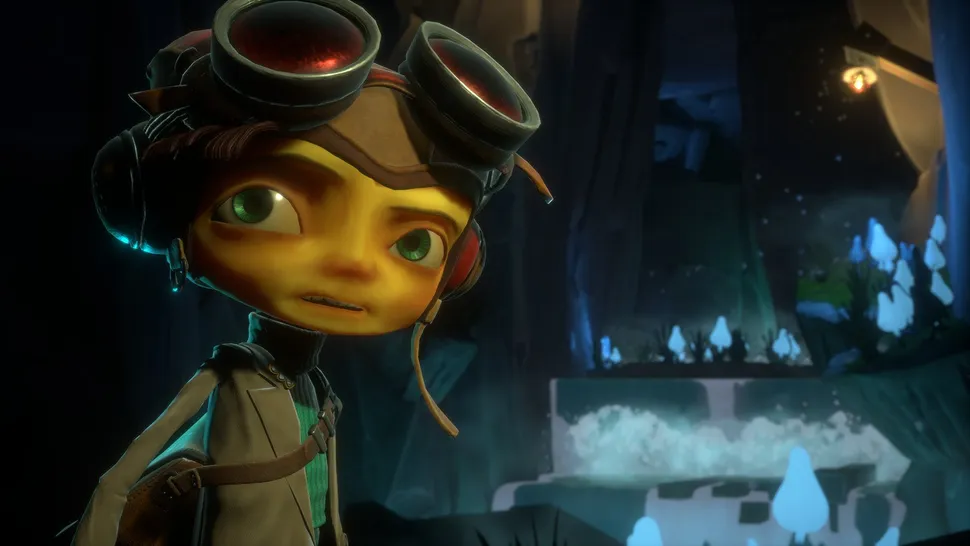
Rumors circulating around the industry suggest that several Xbox Game Studios teams—including Double Fine, Compulsion Games, and Ninja Theory—have, at various points, been evaluated for restructuring or even closure.
Nothing is confirmed, but the existence of those conversations alone signals a deeper issue: a growing impatience with studios that have not yet produced large commercial wins under Microsoft’s ownership.
The problem is that this framing ignores context.
Many of these studios were acquired precisely because of their creative identity, not their immediate ability to deliver blockbuster returns within a fixed corporate cycle. Expecting them to instantly operate like established AAA factories misunderstands both their history and the nature of game development.
Game development is not linear manufacturing. It is iterative, uncertain, and often slow to mature.
Ninja Theory: A Case Study in Unreal Expectations
Few studios illustrate this tension more clearly than Ninja Theory.
The studio has faced a series of compounding challenges over recent years—pandemic disruptions, relocation pressures, and the realities of operating in one of the UK’s most expensive development regions.
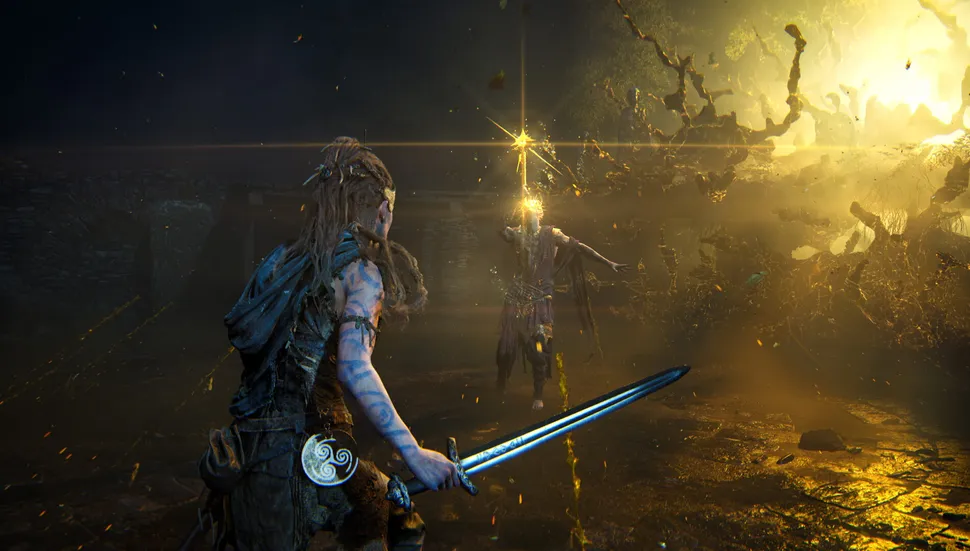
Despite this, Hellblade: Senua’s Sacrifice became a critical success, earning praise for its performance capture, psychological storytelling, and technical achievement. It was widely recognized as a bold, artistically ambitious project.
But commercially, it remained closer to a mid-scale success than a mass-market blockbuster.
And here lies the core tension: Microsoft appears to have greenlit a continuation of that vision without fully resolving the mismatch between ambition and market category.
Hellblade II leaned even further into cinematic presentation and controlled pacing—closer to interactive film than traditional action game. Whether intentional or not, this positioned it in a difficult commercial space: too constrained to compete with large-scale action titles, but too expensive to function as a niche narrative experiment.
The result was predictable in hindsight: strong artistic reception, but muted broader market impact.
Some industry observers have argued that the series might have performed better if it had evolved into a more traditional action-adventure experience—closer in structure to games like God of War, Stellar Blade, or Lies of P—where combat depth and mechanical variety help sustain long-term engagement.
Instead, Ninja Theory found itself caught between identity and expectation, with neither fully aligned.
The Bigger Problem: Short-Term Thinking in a Long-Term Medium
This is not just about one studio or one franchise.
Across Xbox Game Studios, a pattern emerges: ambitious but tightly scoped projects that struggle to break through in an increasingly competitive landscape.
Games like South of Midnight, Avowed, The Outer Worlds 2, Keeper, and Kiln each represent different creative visions, but many of them sit in a difficult middle ground. They are not small enough to be low-risk indie experiments, nor large or disruptive enough to dominate mainstream attention.
And in today’s market, that middle space is increasingly dangerous.
Modern games tend to succeed in one of two ways:
- they become cultural events, backed by massive budgets and marketing power, or
- they are highly distinctive, mechanically innovative, or artistically undeniable in a way that cuts through noise
Anything in between struggles to gain traction.
The issue is not necessarily the talent within these studios. It is the structural environment they are operating in.
The Value Xbox Once Promised Game Pass Could Deliver
Game Pass was often described as a platform that could support exactly this kind of creative diversity. A place where experimental, mid-scale, and narrative-driven games could exist without needing to individually carry blockbuster sales expectations.
In theory, that model should allow studios more breathing room. It should reduce pressure, extend timelines, and encourage risk-taking.
But in practice, the pressure has not disappeared—it has simply shifted. Engagement metrics, retention expectations, and internal cost-per-title analyses now shape decision-making in ways that can be just as restrictive as traditional sales targets.
The Cost of Constant Resetting
One of Xbox’s recurring issues over the past decade has been a tendency toward resets—new strategies, new leadership, new priorities, and often, new cancellations.
The industry has seen promising projects announced early, showcased publicly, and then quietly shelved when internal expectations shift.
This creates more than financial waste. It creates a human cost: teams reorganized mid-development, projects abandoned after years of work, and studios forced to re-justify their existence repeatedly.
Game development already requires extraordinary patience. When that patience is interrupted too frequently, it becomes harder for studios to build anything with long-term coherence.
A Different Approach Is Possible
None of this means every project should be preserved regardless of performance. Studios do need accountability. Not every idea will work, and not every experiment deserves indefinite funding.
But there is a meaningful difference between accountability and premature judgment.
Xbox has demonstrated in the past that it can produce standout successes when given time and stability. Franchises like Gears of War, Forza, and newer projects like Clockwork Revolution, State of Decay 3, Fable, and Sea of Thieves show that the creative capacity is still there.
The question is whether the surrounding structure allows that capacity to fully develop.
Conclusion: Let the Studios Finish Digging
The Persistence analogy is simple, but effective.
Sometimes the difference between failure and success is not talent, or funding, or ambition—but timing. Walking away too early can be indistinguishable from making the wrong bet, even when the underlying idea was sound.
Xbox does not appear to lack talent, vision, or resources. What it increasingly seems to lack is patience.
And in an industry where the best games often take years of iteration to fully form, that may be the most expensive resource of all.
If Microsoft wants Xbox to thrive long-term, it may need to resist the instinct to constantly reassess and retract—and instead allow its studios the time to actually finish what they started.
Because sometimes, the diamonds really are just a little bit further down.