

FTL: Faster Than Light stands as one of the most influential indie strategy games of its era, setting a benchmark for tactical spaceship management that many later titles would attempt to replicate but rarely surpass. With its minimalist pixel presentation, tightly designed systems, and relentlessly tense gameplay loop, it remains a defining example of how simplicity can produce depth.
This review revisits the game after a long break, including time spent with its expanded content, and re-evaluates why it continues to hold such a strong reputation among strategy fans.
A Galaxy on the Edge of Collapse
At its core, FTL places the player in command of a Federation ship carrying critical information across a galaxy consumed by rebellion. The mission is simple in concept but punishing in execution: reach friendly territory while surviving increasingly hostile sectors and ultimately confronting a powerful rebel flagship.
Unlike open-ended space simulators, FTL is structured as a focused escape narrative. Every run is a race against time, and every delay increases pressure from the pursuing rebel fleet. This creates a constant sense of urgency that defines the entire experience.
The galaxy itself is procedurally generated, meaning no two journeys are identical. Encounters, rewards, and dangers shift constantly, forcing adaptation rather than memorization.
Core Gameplay – Controlled Chaos in Real Time
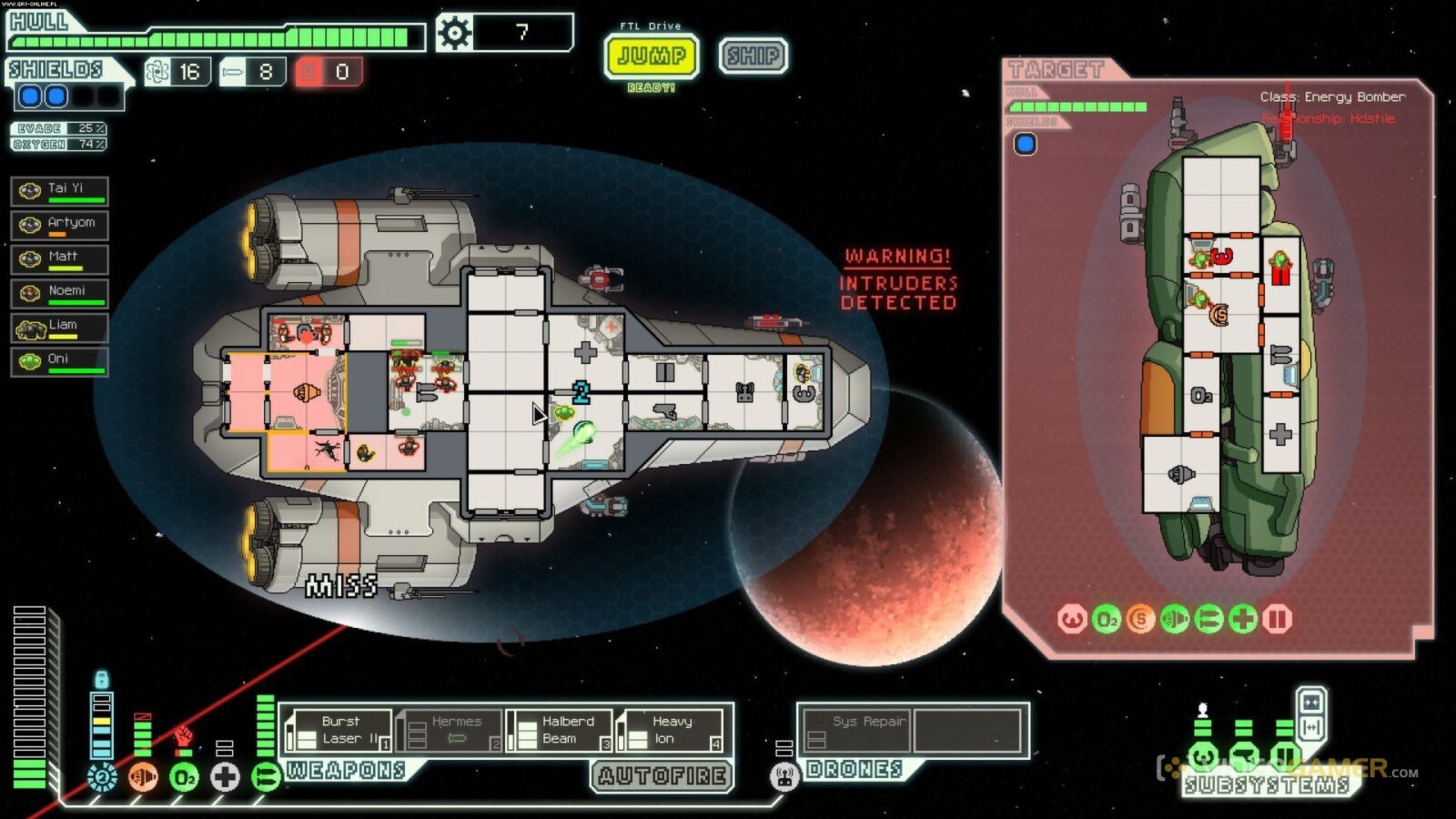
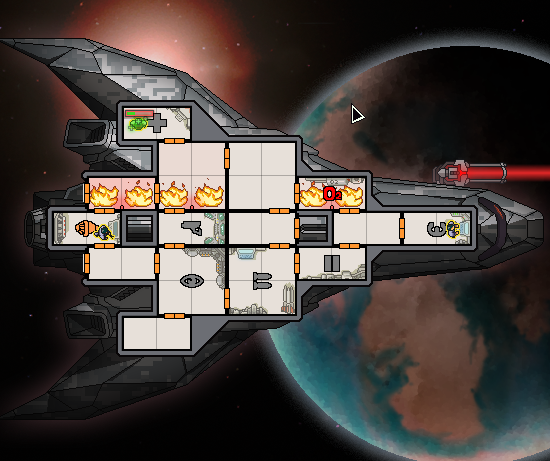
FTL’s gameplay is built around real-time tactical decision-making with a pause system that allows for careful planning. Instead of controlling a ship in traditional movement-based combat, the player manages internal systems: weapons, shields, engines, oxygen, and crew actions.
Combat is about systems disruption. A well-placed missile can disable shields, while a beam weapon can sweep through multiple rooms once defenses are down. Drones, hacking systems, mind control, and boarding parties all expand tactical options further.
Weapon diversity is one of the game’s strongest pillars:
- Missiles bypass shields but require limited ammunition
- Beam weapons reward precise timing and shield management
- Ion weapons disable systems without direct damage
- Drones automate offense or defense functions
- Boarding strategies shift combat into internal ship control
Every encounter becomes a puzzle of resource allocation and counterplay. The tension comes not from speed, but from consequence—every decision has lasting impact.
Ships, Progression, and Strategic Identity
One of the game’s most compelling systems is ship variety. Each vessel starts with different layouts, crew compositions, and equipment. Some begin heavily armored but underarmed, while others rely on drones, cloaking systems, or boarding strategies.
These differences fundamentally alter how each run unfolds. A ship built around boarding tactics plays entirely differently from one focused on long-range laser suppression. This encourages experimentation and replayability through structural variety rather than stat inflation.
Unlocking new ships and layouts becomes a long-term motivation, giving each run a sense of purpose beyond simple survival.
Atmosphere – Minimalist but Powerful
Visually, FTL adopts a clean pixel-art aesthetic that prioritizes readability over realism. While simple, the design is highly effective at communicating information quickly during stressful combat situations.
Where the game truly excels is sound design. The soundtrack is widely regarded as one of the strongest aspects of the experience, blending ambient electronic tones with tension-driven tracks that adapt perfectly to combat and exploration phases.
Together, visuals and audio create a cohesive atmosphere that feels focused, tense, and consistently immersive despite its minimalist presentation.
Interface and Usability
The interface is deliberately simple and highly functional. Systems are clearly displayed, weapon timers are easy to read, and ship layouts are intuitive once learned.
There are minor limitations in icon clarity and some edge-case readability issues, but overall the UI supports fast decision-making without overwhelming the player. This balance is critical in a game where multitasking defines success.
Replayability – Designed for Repetition
FTL is built around repetition by design. Each run is short enough to encourage experimentation, yet complex enough to remain engaging over time.
The inclusion of multiple ships with distinct starting conditions ensures that no two runs feel identical. One attempt may begin with strong shields but weak weapons, while another might rely entirely on drones or cloaking mechanics.
Although there is no true endless mode, the structured run-based design creates its own replay loop. Success is measured in survival and adaptation rather than long-term progression.
Difficulty and Permadeath Design
One of FTL’s defining features is its permadeath system. Failure is permanent. When a ship is destroyed, the run ends immediately.
This design choice dramatically increases tension. Every decision carries weight, and mistakes cannot be undone. Losing crew members, critical systems, or resources early in a run can completely reshape later encounters.
Difficulty settings provide some flexibility, but the core philosophy remains unchanged: survival must be earned, not guaranteed.
Narrative Structure and Player Agency
FTL’s narrative is intentionally minimal and functional. The story exists primarily as a framework for gameplay rather than a deep lore-driven experience.
The structure—race to warn the Federation and defeat the rebel flagship—provides direction, but also imposes strict boundaries. There is little room for freeform exploration or economic playstyles such as trading or long-term sandbox progression.
This linear urgency is effective for tension but limits alternative role-playing styles. Players who prefer open-ended space simulation may find this restrictive.
Modding and Community Expansion
While not built as a heavily moddable platform, FTL has developed a strong modding community over time. Total conversion projects and expansion mods significantly extend gameplay, adding new systems, ships, and mechanics.
One of the most notable examples is “Captain’s Edition,” which introduces additional depth, encounters, and expanded systems that reshape the core experience.
However, modding remains somewhat constrained compared to more open engine designs, limiting how far the game can be transformed.
Final Verdict
FTL: Faster Than Light remains one of the most refined examples of tactical space management ever created. Its strength lies not in graphical fidelity or narrative complexity, but in tightly designed systems that consistently generate meaningful decisions under pressure.
It is not a sandbox space simulator, nor does it attempt to be. Instead, it is a focused survival strategy experience built around tension, adaptation, and consequence.
Despite limitations in openness and mod flexibility, its core design remains exceptionally strong, and its influence on later indie strategy games is undeniable.